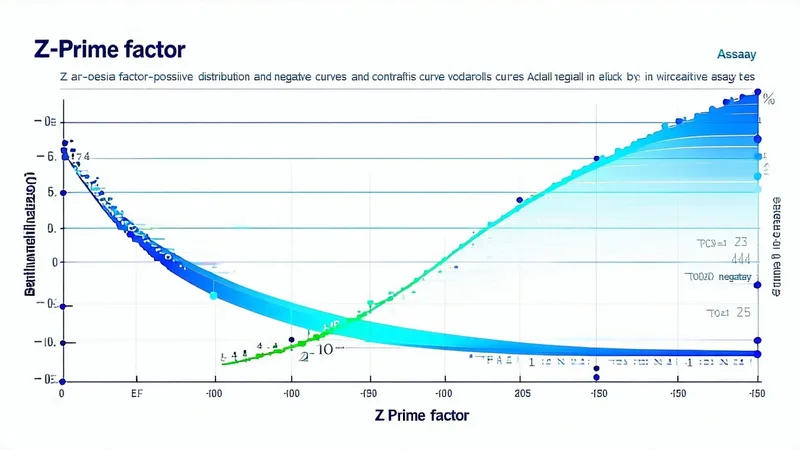
Z' factor is probably the most widely used assay quality metric in high-content screening. Published by Zhang et al. in 1999 as a simple and well-validated way to characterize the statistical separation between positive and negative controls, it has become a universal pass/fail criterion for HCS campaign readiness. A Z' of 0.5 or above is accepted as the threshold for a validated assay. A Z' below 0.5 triggers investigation and, typically, optimization.
The ubiquity of Z' as a metric has generated a parallel problem: it is frequently calculated, frequently reported, and frequently misunderstood. More specifically, the factors that determine Z' are not always clearly distinguished, which means that troubleshooting a failing Z' is often less systematic than it should be.
What the Formula Actually Measures
The Z' factor is defined as:
Z' = 1 – (3σp + 3σn) / |μp – μn|
where μp and σp are the mean and standard deviation of the positive control wells, and μn and σn are the corresponding values for the negative control wells. A Z' of 1.0 represents theoretically perfect separation with zero variance in both controls. A Z' of 0.5 means the "separation band" (the region between the 3σ boundaries of each population) just touches the boundary of the other population — marginally adequate separation.
What this formula does not distinguish is the source of σp and σn. The variance in the control wells reflects the sum of all sources of variability: biological cell-to-cell variance within wells, well-to-well pipetting variance, and imaging-system variance. The formula treats all three contributions identically.
The Imaging Contribution to Control Variance
Imaging system variance enters the control measurements through several mechanisms.
Spatial Intensity Non-Uniformity
A widefield system with 20% center-to-edge illumination fall-off introduces position-dependent intensity bias within each well image. Cells at the periphery appear dimmer than cells at the center. If the per-well statistic is the mean intensity of all detected cells in the well, and cells are distributed across the full imaging field, this spatial bias contributes directly to within-well variance — which adds to σp and σn, reducing Z'.
The magnitude of this contribution depends on the assay read-out. For a cytoplasmic intensity readout that uses mean cell intensity, the contribution is directly proportional to the illumination non-uniformity. For a nuclear segmentation-based count readout, the contribution depends on whether the segmentation algorithm's detection rate varies across the field — which it typically does if the algorithm uses absolute intensity thresholds on uncorrected images.
Temporal Signal Drift
On lamp-based widefield systems, light source output decreases over the lamp lifetime and can vary significantly during the warm-up period (typically 15 to 30 minutes from cold start). If a 384-well plate takes 45 to 90 minutes to image and the first wells are imaged during the lamp warm-up phase, the first column of wells will have systematically different intensities than the later columns. This introduces a systematic spatial pattern in the plate data that is often visible as a column or row effect in the Z' spatial analysis.
Between-plate drift is equally important for multi-day campaigns. If the imaging system is not monitored with a reference sample between runs, it is impossible to know whether the Z' of 0.68 observed on day one and the Z' of 0.51 observed on day four reflect a change in the assay biology or a change in the imaging system performance.
Background Estimation and Subtraction
The background signal subtraction method has a larger effect on Z' than is commonly appreciated. For fluorescence assays with a cell-based readout, the background subtracted from each cell's measured intensity sets the effective zero of the measurement scale. If the background is estimated per-field using a rolling-ball algorithm, the background estimate in a dense region of the field (many cells) will be inflated because the algorithm is measuring the minimum signal in a local neighborhood, which in a dense field is still on a cell. This systematically underestimates background in dense regions and overestimates it in sparse regions, introducing a cell-density-dependent bias into the intensity measurements.
What Z' Tells You and What It Does Not
Z' is a single-point measurement of population separation under ideal conditions — your two most extreme biological states, your positive and negative controls, measured across a subset of wells. It captures the gross separation quality of the assay under those conditions. What it does not capture is the assay's sensitivity to partial agonists or partial inhibitors — compounds that produce effects in the range of 10 to 40% of the maximum response.
We are not saying that Z' is an inadequate quality metric — for its intended purpose, characterizing the dynamic range separation between defined controls, it is well-suited. The limitation is in treating a high Z' as a comprehensive assay quality certificate. An assay can have a Z' of 0.7 and still fail to detect weak-to-moderate activity compounds because the noise floor in the sample wells is higher than in the control wells, or because the assay's dose-response is non-linear in the relevant activity range.
Complementary metrics that should be examined alongside Z' include: the coefficient of variation (CV) of each control population separately, the signal-to-background ratio, and the Strictly Standardized Mean Difference (SSMD), which offers a more statistically stable alternative to Z' in the presence of non-Gaussian control distributions.
Imaging Quality as a Pre-Analytic Determinant of Z'
The practical implication of this analysis is that Z' optimization should proceed in two phases. The first phase is imaging system characterization: verifying illumination uniformity, temporal stability, and background subtraction behavior. If these factors are contributing significantly to the control variance, correcting them at the imaging level (via flatfield correction, lamp warm-up protocol, and appropriate background subtraction) will raise Z' without any change to the biological assay.
Only after the imaging system has been characterized and corrected should attention shift to the biology: reagent concentrations, positive control compound selection, cell seeding density, and incubation conditions. Attempting to optimize the biological components of an assay on an imaging system with uncharacterized optical variance is inefficient — improvements in the biology may be masked by imaging noise, and optimized conditions on the current system may not transfer to a different instrument.
Monitoring Z' as a System Stability Indicator
Z' measured from a stable, well-characterized assay can serve as a system performance indicator across time. If the same positive and negative control cell lines are imaged on the same system under the same conditions, week-to-week variation in Z' reflects variation in system performance rather than biology. A Z' that has been stable between 0.65 and 0.72 for three months but drops to 0.48 in week thirteen is a strong signal that the imaging system has changed — lamp aging, objective contamination, or a laser alignment drift.
This longitudinal use of Z' requires that the imaging conditions are documented with enough precision to reproduce them accurately across sessions, and that the reference assay controls are stored and used consistently. A frozen aliquot of the positive control cell line, thawed and assayed on each campaign start, provides the biological stability needed to isolate imaging-system drift in the Z' trend.
The Z' factor is a useful number that is easier to improve at the imaging layer than at the biological layer — because imaging corrections are systematic and reproducible, while biological optimization is iterative and empirical. Characterizing the imaging contribution before starting assay optimization is a more efficient path to a well-characterized screen than the reverse.